In the fast-evolving world of network design, achieving a Cisco Certified Design Expert (CCDE) certification remains one of the most prestigious milestones for IT professionals. Whether you’re aiming to validate your strategic design thinking or pursue leadership roles in enterprise architecture, mastering the CCDE 400-007 exam is your key to the next level of expertise.
To prepare effectively, thousands of candidates rely on the latest verified CCDE 400-007 dumps from — https://www.leads4pass.com/400-007.html offering authentic, up-to-date practice materials that mirror real exam conditions. These dumps help you bridge the gap between theory and real-world design challenges, ensuring you approach the exam with confidence and precision.
What Makes the CCDE 400-007 Certification So Valuable
The CCDE certification sits at the pinnacle of Cisco’s design certification hierarchy. Unlike configuration-heavy credentials, CCDE tests your ability to translate business needs into scalable network architectures.
Holding this certification demonstrates that you:
- Understand multi-domain enterprise design principles;
- Can build resilient and secure infrastructures;
- Have a strategic vision that connects technology decisions to business outcomes;
- Are ready for leadership roles in network architecture, consulting, or digital transformation projects.
In 2025 and beyond, organizations are shifting toward AI-driven, automated, and cloud-optimized network environments. This makes the CCDE not only a technical certification but a strategic leadership credential — positioning certified experts at the core of digital evolution.
A Deep Dive into the CCDE 400-007 Exam Blueprint
The 400-007 written exam assesses your ability to design end-to-end solutions that meet specific technical and business objectives. It is designed to test strategic reasoning.
| Category | Details |
|---|---|
| Exam Code | 400-007 |
| Duration | 120 minutes |
| Format | Multiple-choice, multiple-response, drag-and-drop |
| Question Count | 90–110 |
| Delivery | Pearson VUE |
| Prerequisite | None (advanced experience recommended) |
Key Domains
- Design Methodology and Principles – Evaluating network design frameworks and lifecycle strategies.
- Infrastructure Design – Assessing routing, switching, and transport topologies.
- Security and Governance – Embedding compliance, access control, and risk mitigation in design.
- Cloud and Hybrid Architecture – Integrating on-premises, hybrid, and multi-cloud solutions.
- Automation and AI-Enabled Design – Leveraging automation and analytics to enhance network scalability.
Each question simulates a real-world design scenario, where you must assess requirements, constraints, and performance trade-offs to select the most effective design approach.
The Evolution Toward AI-Driven Design
As networks continue to expand in complexity, Cisco’s certification framework increasingly emphasizes AI and automation integration. The CCDE exam now reflects this shift, introducing design scenarios that include:
- AI traffic pattern optimization;
- Machine learning-based network operations;
- Predictive analytics for fault detection;
- Automation pipelines for service provisioning.
Candidates are expected to understand how AI principles influence network design decisions — from data center layout to cloud-native service orchestration. This knowledge prepares you to design intelligent, self-optimizing networks capable of supporting digital-first enterprises.
Why Authentic 400-007 Dumps Are Essential for CCDE Success
Preparing for the CCDE exam without reliable study materials can feel like navigating a maze. That’s why most successful candidates choose authentic, validated exam dumps — not as shortcuts, but as structured learning aids that reflect the true nature of the test.
The latest CCDE 400-007 dumps from Leads4Pass provide:
- 410 verified questions and answers aligned with Cisco’s current exam objectives;
- A mix of PDF and VCE formats for flexible study;
- Continuous updates validated by certified professionals;
- Scenario-based questions that mirror real-world design cases;
- Explanations designed to reinforce conceptual understanding rather than rote memorization.
Using these dumps strategically helps you identify knowledge gaps, strengthen design reasoning, and reduce test anxiety — allowing you to perform confidently on exam day.
For those looking to test their readiness, here are the most up-to-date CCDE 400-007 practice questions you can review before your exam
Latest CCDE 400-007 Exam Questions and Answers
To help you stay aligned with the most current exam trends, below are the latest verified CCDE 400-007 practice questions and answers collected from active test-takers and verified study sources..
Some candidates may also want to compare the previous CCDE 400-007 dumps questions and answers, so I have compiled the previous ones into a PDF. You can click to download the 2024 CCDE 400-007 Dumps PDF.
| Launch time | Related | Free download |
| Nov 2025 | DevNet Associate,CCIE,CCNP… | Latest CCDE 400-007 Dumps PDF |
Question 1: What is a primary factor prior to migration?
A European national bank considers migrating its on-premises systems to a private cloud offering in a non-European location to significantly reduce IT costs.
A. data governance
B. additional latency
C. security
D. cloud connectivity
Correct Answer: A
Explanation:
Refer vn mentioned below, political issue is the highest priority and mandatory.
When considering moving out the data, you need to consider the place allowed, rather than how to move or store. Even you have a very high security to protect data, if the government don\’t allowed you to place in the desired country, then
you still cannot do that.
Question 2: What is the result if the controller fails?
A business invests in SDN and develops its own SDN controller that, due to budget constraints, runs on a single controller. The controller actively places an exclusive lock on the configuration of the devices to ensure it is the only source of changes to the environment.
A. All device configurations are in read-only mode until the controller is restored.
B. The control plane is unavailable until the controller is restored.
C. If a device fails, the configuration backup is unavailable
D. Manual changes are only possible until the controller is restored
Correct Answer: A
Question 3: Which two impacts of adding the IP event dampening feature to a network design are true?
(Choose two.)
A. It protects against routing loops.
B. It switches traffic immediately after a link failure.
C. lt speeds up link failure detection.
D. It reduces the utilization of system processing resources.
E. It improves overall network stability.
Correct Answer: DE
Question 4: What is an optimal solution for this deployment to configure BGP relationships and redistribute BGP learned routes into OSPF?
Refer to the exhibit.
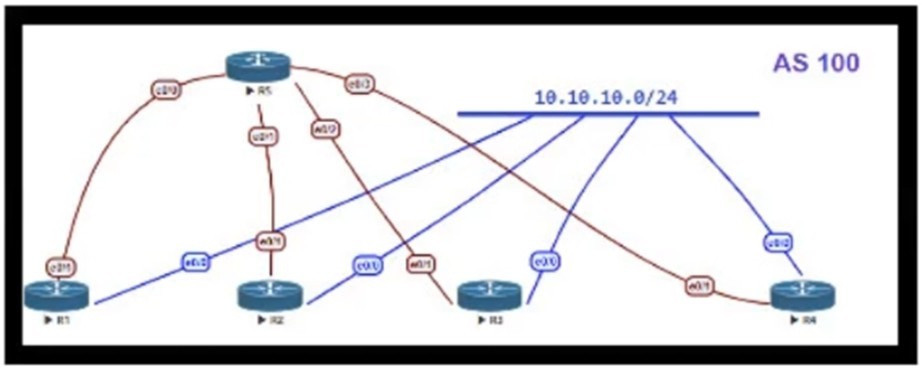
OSPF is running as the IGP to provide reachability to all AS100 networks R3 and R4 are the current ABRs at the boundary of OSPF Area0 and Areal Now BGP must be deployed within AS 100 because it will be receiving Internet routes from its eBGP peers (the service provider) connected to R1 and R2.
A. R5 should be configured as a route reflector for R1, R2, R3 and R4. BGP routes must be redistributed at R1 and R2 into OSPF.
B. Configuration should be set up with R1 and R2, and R3 in one sub AS, with and R4 in another, and redistribution at R1 and R2.
C. A full mesh should be deployed between all the routers with mutual redistribution to take place at R1 and R2.
D. R1, R2, R3 and R4 must be set up with a neighbor relationship with R5 only must not be a route reflector.
Correct Answer: A
Question 5: Which IPsec tunneling feature can they enable to optimize the data flow while ensuring that the headers contain no duplicate IP addresses?
Company XYZ has designed their network to run GRE over IPsec on their Internet-based VPN to connect two sites.
A. Transport Mode in IPsec Phase I
B. Transport Mode in IPsec Phase II
C. Tunnel Mode in IPsec Phase II
D. Tunnel Mode in IPsec Phase I
Correct Answer: B
Question 6: Which two mechanisms avoid suboptimal routing in a network with dynamic mutual redistribution between multiple OSPFv2 and EIGRP boundaries?
(Choose two.)
A. AD manipulation
B. matching OSPF external routes
C. route tagging
D. route tagging
E. route filtering
F. matching EIGRP process ID
Correct Answer: AD
Explanation:
To solve this type of problem, the redistributing routers must have some awareness of which routes came from the other routing domain. In particular, the lower-AD routing protocol needs to decide which routes came from the higher-AD routing protocol, and either use a different AD for those routes or filter the routes.
https://www.ccexpert.us/routing-switching-2/mutual-redistribution-at-multiple-routers.html
Question 7: Which technology can be used to mitigate this issue?
As part of workspace digitization, a large enterprise has migrated all their users to Desktop as a Sen/ice (DaaS), by hosting the backend system in their on-premises data center. Some of the branches have started to experience disconnections to the DaaS at periodic intervals, however, local users in the data center and head office do not experience this behavior.
A. tail drop
B. traffic shaping
C. WRED
D. traffic policing
Correct Answer: B
Question 8: Which security measure prevents the new endpoint from learning an IPv6 prefix from an attacker?
Company ABC uses IPv4-only. Recently they started deploying new endpoint devices. For operational reasons, IPv6 cannot be disabled on these new endpoint devices.
A. Source Guard and Prefix Guard
B. Router Advertisement Guard
C. Prefix Guard
D. Secure Neighbor Discovery
Correct Answer: B
Question 9: What is a characteristic of a secure cloud architecture model?
A. limited access to job function
B. dedicated and restricted workstations
C. multi-factor authentication
D. software-defined network segmentation
Correct Answer: D
Question 10: Which segmentation method is suitable and scalable for the customer?
A customer has a functional requirement that states HR systems within a data center should be segmented from other systems that reside in the same data center and same VLAN. The systems run legacy applications by using hard-coded IP addresses.
A. data center perimeter firewalling
B. VACLs on data center switches
C. transparent firewalling
D. routed firewalls
Correct Answer: B
Explanation:
VLAN (Virtual LAN) is a concept in which we divide the broadcast domain into smaller broadcast domains logically at layer 2.
If we create different VLANs then by default, a host from one VLAN can communicate with all the hosts residing in the same VLAN. If we want some hosts not able to reach other hosts within the same VLAN, then the concept of VLAN Access-list or Private VLAN can be used.
Question 11: Which of these must you consider when developing the routing and NAT design?
You are designing the routing design for two merging companies that have overlapping IP address space.
A. Local to global NAT translation is done after routing
B. Global to local NAT translation is done before routing.
C. Local to global NAT translation is done before policy-based routing
D. Global to local NAT translation is done after policy-based routing.
Correct Answer: B
Question 12: Which two features improve STP stability within the network design?
Refer to the exhibit.
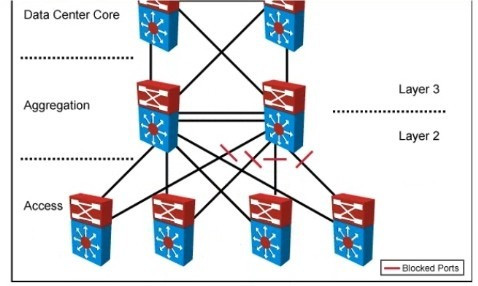
Your company designed a network to allow server VLANs to span all access switches in a data center In the design, Layer 3 VLAN interfaces and HSRP are configured on the aggregation switches. (Choose two.)
A. BPDU guard on access ports
B. BPDU guard on the aggregation switch downlinks toward access switches
C. root guard on the aggregation switch downlinks toward access switches
D. root guard on access ports
E. edge port on access ports
F. access switch pairs explicitly determined to be root and backup root bridges
Correct Answer: AE
Question 13:
Refer to the exhibit.
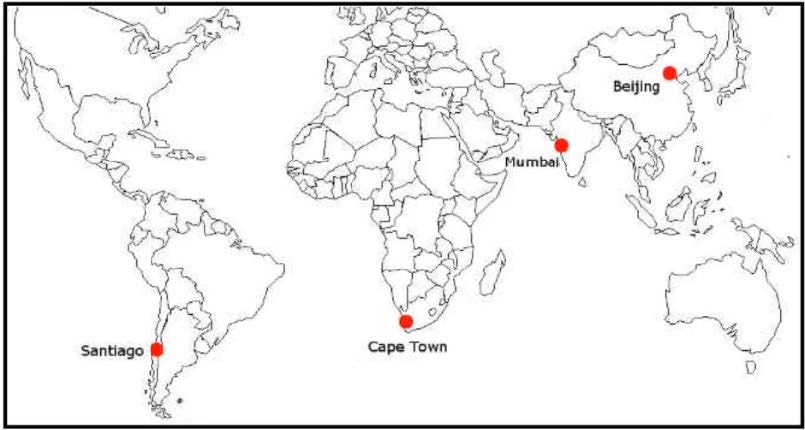
ACME Mining has four data centers in Santiago. Cape Town. Mumbai, and Beijing, full- mesh connected via a 400 Mb/s EVP-LAN They want to deploy a new mission-critical application with these requirements:
1.
cluster heartbeat 2 Mb/s continuous (250 KB/s)
2.
cluster heartbeat one-way maximum latency 100 ms
These are the current ping tests results between the four data centers:
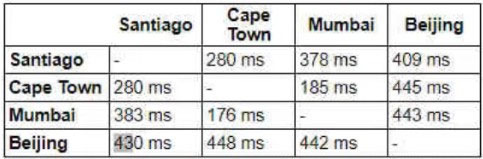
Which hosting data center pair can host the new application?
A. Mumbai and Beijing
B. Santiago and Cape Town
C. Santiago and Mumbai
D. Cape Town and Mumbai
E. Cape Town and Beijing
F. Santiago and Beijing
Correct Answer: D
Question 14: Which two features control multicast traffic in a VLAN environment?
(Choose two)
A. IGMP snooping
B. MLD snooping
C. RGMP
D. PIM snooping
E. pruning
Correct Answer: AB
Question 15: What happens when the link between R2 and R3 is restored?
Refer to the exhibit.
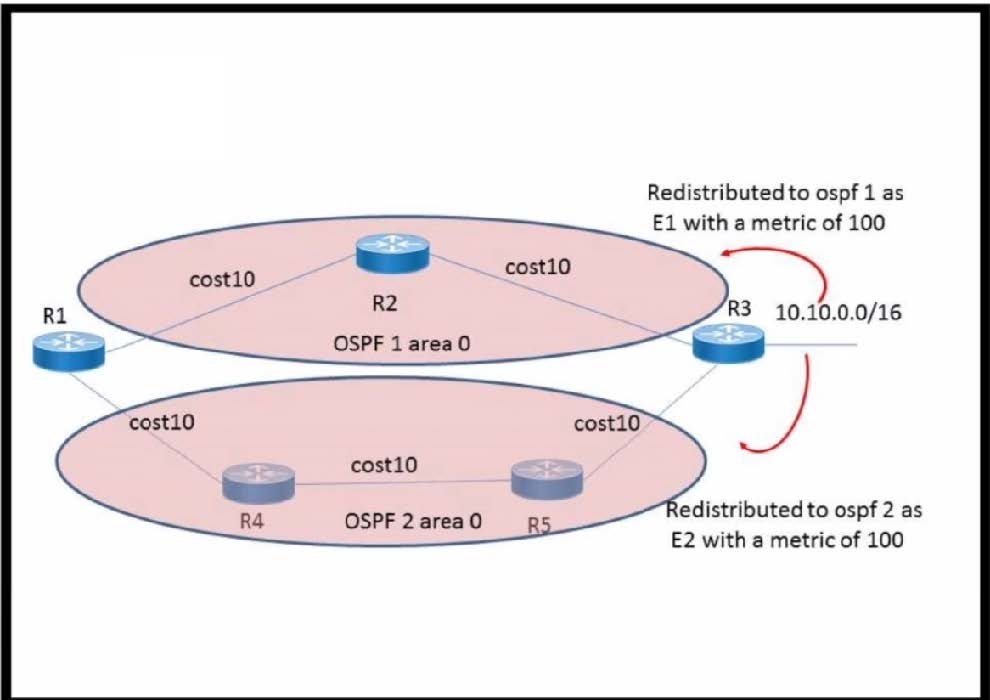
The network 10.10.0 .0/16 has been redistributed to OSPF processes and the best path to the destination from R1 has been chosen as R1-R2-R3 A failure occurred on the link between R2 and R3 and the path was changed to R1-R4-R5-R3.
A. The path R1-R4-R5-R3 continues to be the best path because the metric is better
B. The path reverts back to R1-R2-R3 because the route type is E1
C. The path R1-R4-R5-R3 continues to be the best path because OSPF does not compare the metrics between two domains
D. The path reverts to R1-R2-R3 because this was the previous best path
Correct Answer: D
Explanation:
When the link between R2 and R3 is restored, the path reverts back to R1-R2-R3 because this was the previous best path. This is because OSPF uses the Dijkstra algorithm to calculate the shortest path tree (SPT) and the path with the lowest cost is chosen as the best path.
In this case, the cost of the path R1-R2-R3 is lower than the cost of the path R1- R4-R5-R3, so the path R1-R2-R3 is chosen as the best path.
OSPF also has a preference order for different types of routes, such as intra-area, inter-area, external type 1, external type 2, NSSA type 1, and NSSA type 2.
However, this preference order only applies when OSPF has to choose between routes of different types to the same destination. In this scenario, both paths are external type 2 routes, so the preference order does not affect the path selection
…
Now that you’ve reviewed the most recent exam patterns, let’s focus on how to prepare strategically and efficiently.
Practical Study Strategies for CCDE 400-007 Candidates
To maximize your chances of success, your preparation plan should combine structured study, hands-on practice, and continuous review.
1. Follow the Official Blueprint
Start by reviewing Cisco’s latest exam blueprint and aligning your preparation topics with it. Every domain in the dumps directly maps to the official guideline, ensuring your effort is focused.
2. Simulate Real Exam Conditions
Use 400-007 VCE to replicate the timed exam environment. This builds confidence, improves pacing, and familiarizes you with Cisco’s question logic.
3. Learn Design Thinking
The CCDE isn’t about memorizing commands — it’s about architectural thinking. Practice case studies that force you to balance business needs, scalability, and security trade-offs.
4. Join Professional Communities
Engage in discussions on the Cisco Learning Network or peer study groups. These forums offer invaluable real-world insights from certified experts.
5. Review and Reflect
After every mock exam, spend time analyzing incorrect answers. Focus on understanding the why behind design choices — that’s the essence of becoming a true design expert.
The Role of CCDE 400-007 in Modern Enterprise Design
Today’s enterprise environments are hybrid, distributed, and increasingly automated. The CCDE certification validates your ability to design systems that bridge networking, cloud, and AI — the three pillars of modern digital infrastructure.
Holding this certification can open doors to roles such as:
- Network Architect or Principal Engineer
- Infrastructure Consultant
- Enterprise Design Lead
- Technology Strategist for AI or Cloud Projects
As more organizations adopt software-defined and AI-enhanced networks, CCDE-certified professionals are in demand for their ability to design adaptable, secure, and high-performance systems that can evolve with business growth.
How to Choose the Right Study Resources
The internet is filled with study materials, but not all are accurate or aligned with Cisco’s standards. Here’s how to identify reliable ones:
| Resource Type | Recommended Use | Notes |
|---|---|---|
| Official Cisco Blueprint | Defines topics and objectives | Always start here |
| Leads4Pass Dumps (PDF/VCE) | Exam-aligned practice | Verified and frequently updated |
| Cisco Learning Network | Peer support and discussion | Great for scenario-based learning |
| Books & Whitepapers | Deep conceptual learning | Use selectively to fill knowledge gaps |
The combination of Leads4Pass verified dumps and Cisco’s official materials offers the most balanced preparation — blending accuracy with practicality.
Common Mistakes Candidates Should Avoid
Even experienced professionals can stumble on the CCDE exam due to poor strategy. Avoid these pitfalls:
- Ignoring Cisco’s blueprint updates, assuming older materials still apply;
- Neglecting business perspective questions — CCDE is not purely technical;
- Skipping time management practice;
- Not reviewing wrong answers after mock exams.
Each of these mistakes can cost valuable points, so treat your preparation like a design project — systematic, analytical, and iterative.
Final Preparation Checklist
Before your exam date, ensure you’ve covered all essentials:
- ✅ Master the five blueprint domains
- ✅ Practice every scenario type (single-choice, multiple-choice, drag-and-drop)
- ✅ Use Leads4Pass 400-007 dumps for realistic simulation
- ✅ Join online CCDE study groups
- ✅ Rest and reset your focus before exam day
A well-rounded approach ensures you don’t just pass — you excel.
Conclusion
The CCDE 400-007 certification remains one of Cisco’s most respected and future-proof credentials. It validates not just what you know, but how you think — how you connect business vision with technical reality.
Whether you’re designing multi-domain architectures, integrating AI systems, or optimizing hybrid networks, the CCDE empowers you to lead innovation with confidence.
For comprehensive preparation, access the latest verified dumps and study materials at https://www.leads4pass.com/400-007.html. They’re designed to align with the current Cisco blueprint and guarantee a smooth path toward certification success.
Study smart, think strategically, and become the architect every organization needs.
![[2017 New] Latest Cisco 642-112 Exam Practice Materials Online Free Download](https://www.pursue4pass.com/wp-content/themes/instorm/img/thumb-medium.png)